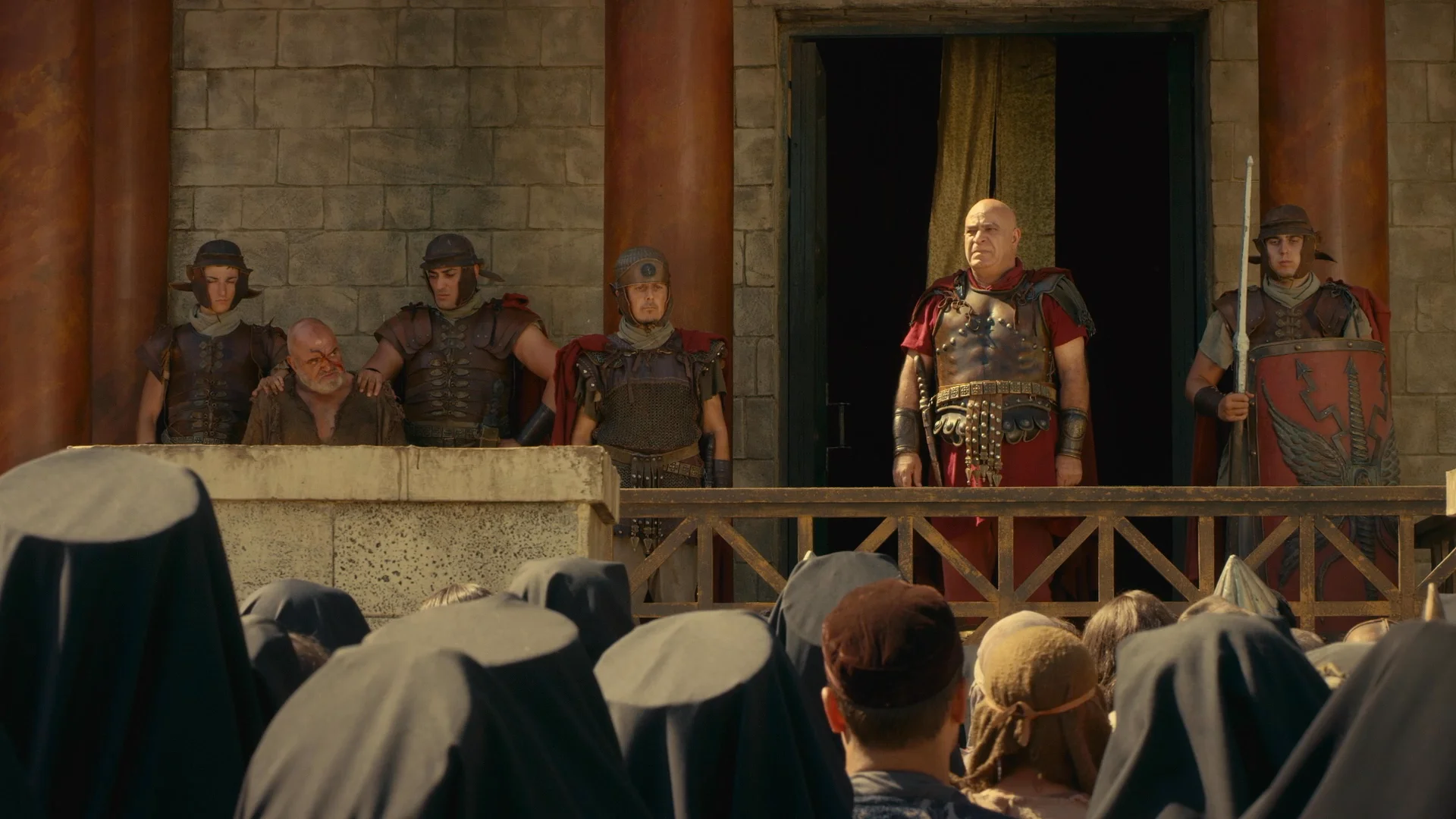
The accusations, hearings and final decision
From the council's condemnation to Pilate's sentence
The religious charge centered on Jesus' identity. Matthew records that the high priest put Jesus under oath and asked whether he was the Messiah, the Son of God. After Jesus answered, the high priest accused him of blasphemy, and those judging him declared that he deserved death (Matthew 26:63–66). Blasphemy was the council's judgment of his answer; the accusation should not be confused with a finding that Jesus had committed a political offense against Rome.
A death sentence required Roman involvement. John records that when Pilate told Jesus' accusers to judge him under their own law, they replied that they had no right to execute anyone (John 18:31). This explains why the religious leaders brought Jesus to the governor: their condemnation did not itself give them legal authority to carry out his execution. [1]
Before Pilate, the accusations concerned public order and Roman rule. Jesus' accusers alleged that he was subverting the nation, opposing payment of taxes to Caesar, and claiming to be the Messiah, a king. Luke records these as accusations, while Pilate said he found no basis for a charge against Jesus. On learning that Jesus was a Galilean, Pilate sent him to Herod, who was also in Jerusalem (Luke 23:1–7).
Herod wanted to see Jesus perform a miracle and questioned him at length, but Jesus gave him no answer. The chief priests and teachers of the law continued accusing him. Herod and his soldiers mocked Jesus, dressed him in a splendid robe, and sent him back to Pilate (Luke 23:8–11). Herod's questioning therefore ended with Jesus being sent back to Pilate (Luke 23:8–11).
Barabbas became central to the demand for a prisoner's release. He was imprisoned for involvement in a rebellion and for murder (Luke 23:19). Mark records that the chief priests stirred up the crowd to ask Pilate to release Barabbas instead of Jesus. When Pilate asked what he should do with Jesus, the crowd demanded crucifixion (Mark 15:6–14). The choice of Barabbas was a request for his release, not evidence establishing the accusations against Jesus. [2]
Pilate ultimately granted the crowd's demand. Mark records that, wanting to satisfy the crowd, he released Barabbas, had Jesus flogged, and handed him over to be crucified (Mark 15:15). The decisive step toward execution was Pilate's authorization: the governor yielded to the crowd's demand and handed Jesus over to be crucified (Mark 15:15). [2]